

So..........what is the best footrest for office work? The answer depends on your body, your workstation and how much you move during the day.
Let’s break it down 👇
Why foot support matters more than you realise
Your body works as a connected system. Physiotherapists often describe this as a kinetic chain:
Feet → ankles → knees → pelvis → lower back → shoulders → neck
When your feet dangle or constantly search for support, your pelvis can tilt backwards. Your lower back then loses some of its natural support, and you may compensate by rounding your shoulders or leaning towards your screen.
That means a small problem under your desk can contribute to a much bigger posture problem above it.
A supportive footrest helps you work towards the familiar 90-90-90 position:
- Hips at approximately 90 degrees
- Knees at approximately 90 degrees
- Ankles at approximately 90 degrees
- Feet fully supported
- Thighs roughly horizontal
- Knees around the same height as your hips
This is not a rigid pose you must hold all day. You still need to move, stand and change positions regularly.
But a supported foundation gives your body a better starting point.
A supported foundation = a more supported spine.
It can also reduce pressure behind your thighs
When your chair is too high, your feet may not reach the floor. You might compensate by stretching your legs forward, balancing on your toes or pressing the backs of your thighs into the seat edge.
That pressure can become uncomfortable and may leave your legs feeling heavy or restless.
OSHA workstation guidance recommends that your feet rest flat on the floor or on a stable footrest when your desk and chair cannot be adjusted enough to achieve a neutral posture. Its guidance also recommends a footrest that supports both feet and has a stable, non-slip surface.
You can read the OSHA computer workstation guidance for more detail.
The main types of office footrest compared
There is no single best footrest for every person. Here are the main options, and where each one works best.
1. Floor or under-desk footrest
This is the standard footrest under desk. It sits on the floor and provides a raised platform for both feet.
What it does well:
- Usually affordable
- Easy to move between workstations
- Available in fixed, angled or height-adjustable designs
- Can support both feet comfortably
- Works well in a dedicated home office
Where it falls short:
- It may slide across hard floors
- It can take up valuable legroom
- It may become difficult to use with a chair on casters
- If you roll or swivel your chair, the footrest stays behind
Here’s the catch: a floor footrest supports your feet, but it does not necessarily stay connected to your seating position.
That is the honest limitation of most traditional models.
2. Angled or tilted footrest
An angled desk footrest raises the toes slightly and can help position the ankles more comfortably.
Best for:
- People who prefer a firm platform
- Users who want to reduce ankle strain
- Workstations where the feet need a little extra height
- Anyone who likes a more forward-tilted position
Look for a non-slip surface and a stable base. OSHA-related guidance recommends that angled footrests remain stable and support both feet.
3. Rocking footrest
A rocking or tilting footrest allows gentle movement through the ankles while you work.
What it does well:
- Encourages small changes in leg position
- Can feel more comfortable than a completely fixed platform
- May help reduce the feeling of static sitting
- Gives you something to move against during long tasks
Potential drawback: a rocking design may not suit you if you prefer maximum stability or tend to press heavily through your feet.
Movement is useful, but it should feel controlled, not like you are constantly chasing the footrest.
4. Foot hammock or sling
A foot hammock hangs beneath the desk and supports your feet in a suspended position.
Best for:
- Travelling or temporary workstations
- People with limited floor space
- Occasional use at home
- Relaxed seated positions
Limitations include:
- Less stable than a solid platform
- Usually supports less active movement
- May not provide the same firm base for both feet
- Can be awkward to position under some desks
It is a useful comfort accessory, but it may not be the best choice if your primary goal is stable ergonomic support.
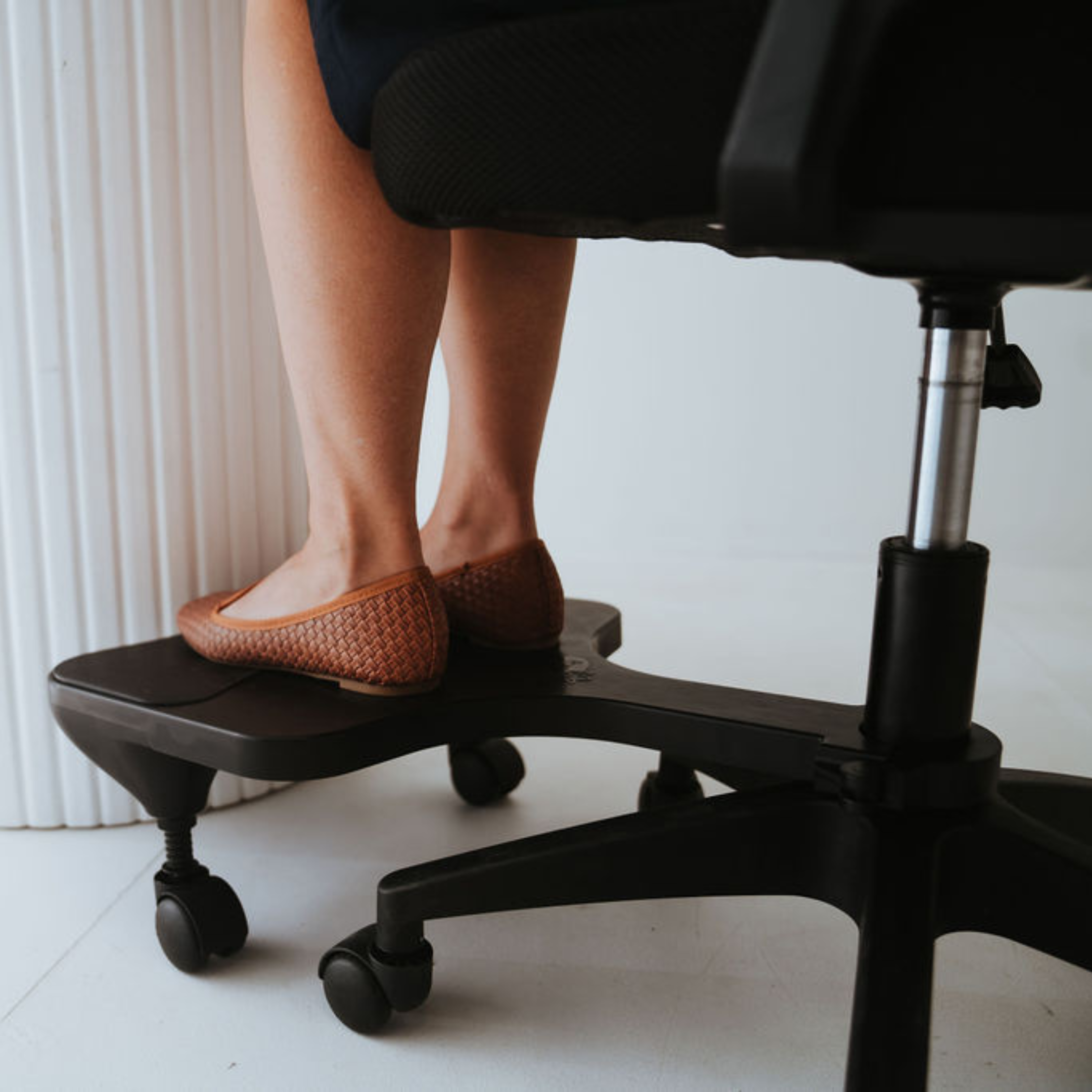
5. Chair-mounted footrest
A chair mounted footrest attaches directly to your office chair rather than sitting loose on the floor.
This design solves the problem most floor models cannot: the support moves with you.
A chair-mounted footrest can be particularly useful if you:
- Roll your chair throughout the day
- Change your sitting position frequently
- Work at a shared or compact desk
- Have limited floor space
- Want a foot rest for office chair use that stays in place
The key question is simple:
Does the footrest stay where your feet need it, or do you need to keep finding it?
That is exactly why a footrest attaches to chair design can be a better fit for people who move while working.
What to look for when buying an ergonomic footrest
Use this checklist before choosing an adjustable footrest:
Attachment system
If you are considering a chair-mounted option, check:
- How securely it attaches
- Whether it suits your chair design
- Whether your chair has a central pole and base
- Whether installation requires specialist tools
- Whether it remains stable during normal chair movement
PostureAssist is designed for most office-style chairs with a central pole and base. If you are unsure, contact the PostureAssist team before ordering.
Height adjustability
Your feet should be supported without forcing your knees too high or leaving your thighs under pressure.
An adjustable footrest is especially useful when:
- You are shorter than average
- Your desk has a fixed height
- Several people share the same workstation
- You alternate between different chairs
- You work from both home and the office
Tilt and movement
A gentle tilt can help you adjust your ankle position. Rocking movement can help reduce static sitting.
The best option is the one that gives you control, not one that moves unpredictably.
Stability
Check for:
- A solid platform
- A secure base
- Non-slip contact points
- A surface that does not shift when you reposition your feet
Surface area and texture
Both feet should fit comfortably without hanging over the edge.
A textured platform can help prevent your shoes or socks from sliding, while a broad surface gives you more freedom to change position.
Weight capacity and materials
Look for durable materials designed for everyday use. PostureAssist is made from strong ABS injection-moulded plastic for use in home and professional environments.
Where it is made
For Australian workplaces, locally made products can make procurement, support and product accountability simpler. PostureAssist is Australian owned and made, with a focus on practical workplace comfort.
The height gap problem: why shorter workers often struggle
Most desks are built to a fairly standard height. Most people are not.
If you lower your chair so your feet reach the floor, your arms may sit too low for the desk. If you raise your chair so your wrists are comfortable, your feet may dangle.
That creates an uncomfortable trade-off:
- Feet supported, wrists too low
- Wrists supported, feet left unsupported
A footrest helps close that gap without forcing you to compromise your upper-body position.
It is also useful in hot-desking environments, where one fixed desk needs to accommodate people with very different heights and proportions.
Who benefits most from an office chair footrest?
A footrest can help anyone who spends long hours seated, but it is especially valuable for:
- Shorter-statured workers whose feet do not reach the floor
- Remote workers using kitchen tables or non-standard desks
- Hybrid employees moving between home and office setups
- Hot-desk users sharing workstations
- People who already experience lower-back, hip, knee or leg discomfort
- Businesses building a practical range of office ergonomics accessories
- WHS and procurement teams looking for a simple, low-space intervention
Musculoskeletal discomfort is common among computer-based workers. Reviews of remote and office work report frequent symptoms in the neck, shoulders and lower back, particularly where workstations are poorly adjusted or sitting time is high. See this systematic review of work-from-home musculoskeletal disorders and this review of teleworking and musculoskeletal health.
A footrest is not a cure for pain. But it can address one often-overlooked part of a broader ergonomic setup.
Questions to ask about your own workstation
Before you buy, sit at your desk and ask:
- Are both feet fully supported?
- Are my knees roughly level with my hips?
- Am I pressing the backs of my thighs against the chair?
- Do I regularly tuck one foot under me or sit on one leg?
- Do I keep shifting because I cannot find a stable position?
- Does my floor footrest move away when I roll my chair?
- Is my desk too high for my chair to be comfortable?
- Do I share my workstation with other people?
- Would a chair-mounted footrest give me more consistent support?
- Can I adjust my setup without creating pressure elsewhere?
If you answered “yes” to several questions, your feet may be the missing piece.
So, what is the best footrest for office work?
For a fixed workstation, a stable under-desk footrest can be a practical and affordable choice.
For a setup where you move, swivel or share space, a chair-mounted adjustable footrest offers a more integrated solution. It keeps your support with your chair instead of leaving it behind on the floor.
PostureAssist is designed to attach directly to your office chair, move with you and support a more comfortable seated position. It is adjustable, easy to install and made in Australia.
👉 Explore the PostureAssist Foot Rest
Your feet do more than touch the floor.
They help set the position for everything above them.
Support. Align. Move more comfortably.


0 comments